

Every framer has gotten it. The walls are hung, taped and painted, and now the cabinet installer, the TV guy or the inspector wants to know where the backing is. If it isn’t there, somebody is cutting open finished drywall.
The fix is simple: if you’re going to hang cabinets on metal studs, mount a TV or install grab bars, the backing goes in while the wall is still open. This guide covers why metal stud walls need it, the backing options framers use, what each item on the wall calls for, and how to plan it so it’s on the truck the first time.
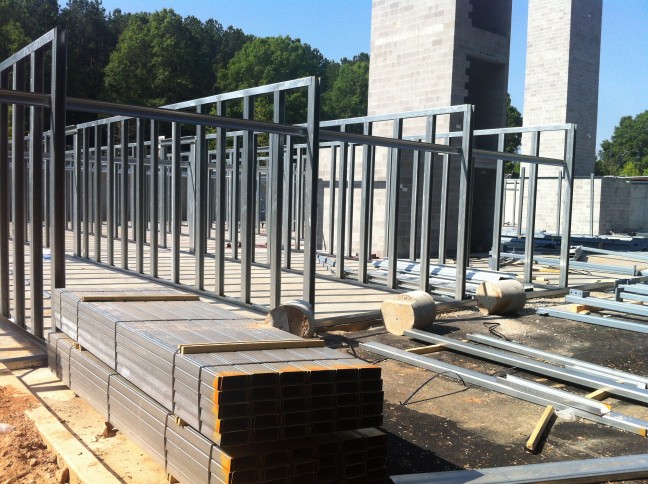
A metal stud is strong along its length, but the part you screw into is a thin steel flange. A screw in a wood stud grabs over an inch of solid lumber. A screw in a steel flange grabs a few threads in sheet metal. That’s plenty for drywall. It’s not enough for a loaded upper cabinet or a TV on a full-motion arm.
The studs also don’t always land where the mount needs them. Studs at 16 or 24 inches on center rarely line up with a cabinet’s hanging rail, a grab bar’s flanges or a TV mount’s bolt pattern. Backing gives the installer something solid to fasten into anywhere across the bay.
TV mount makers say the same thing. Vogel’s tells installers that metal stud walls need an added back plate before mounting a TV, because the studs are flexible enough that a mount fastened straight to them can pull loose. Some mounts, like a Philips model we checked, aren’t rated for metal stud walls at all.
None of this is a knock on steel framing. A wood-framed wall still needs blocking for most of these items too, because the studs never land in the right spot. The difference is that with steel, the backing has to be planned instead of improvised with a scrap 2×4 at the last minute. If you’re new to how stud thickness affects this, our guide to steel stud gauges, mils and designations explains what the numbers on the stud mean.
There are three common ways to put backing in a steel-framed wall. Which one you use usually comes down to what the drawings call for, what’s going on the wall and how fast your crew needs to move.
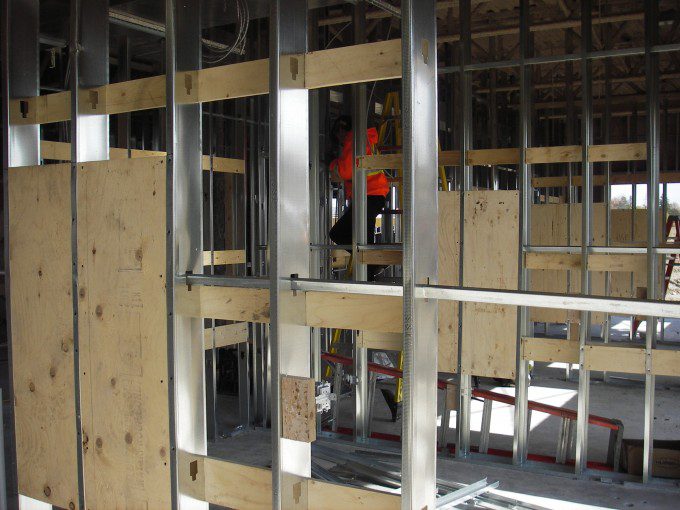
Flat strap is a strip of galvanized steel screwed across the face of the studs, behind the drywall. Steel framing manufacturers list backing for cabinets, shelves, handrails and fixtures as one of its standard uses, right alongside bridging and bracing. It’s cheap, it comes off the same truck as your studs and track, and it gives the installer a continuous steel band to screw into anywhere along the wall.
It’s the same material we covered in bridging and bracing metal studs, doing a different job. You can see sizes and current prices on our flat strap and accessories pricing table.
Wood blocking between or across the studs is still the most familiar option, and a lot of finish carpenters prefer it because their screws bite the way they expect. A common question is whether wood is even allowed in a noncombustible building. The International Building Code answers it directly: Section 603.1 lists blocking for handrails, millwork, cabinets and window and door frames as an allowed use of combustible material in Type I and II construction.
Many project specs still call for fire-retardant-treated (FRT) wood, so read the drawings before you buy. Plain lumber and FRT are not interchangeable once a spec names one.
Several manufacturers make backing built to fit between metal studs, which saves the labor of cutting and notching wood to fit. ClarkDietrich, Simpson Strong-Tie and The Steel Network all make them, and they come in two main styles.
Steel backing spans between studs and screws into the flanges. The ClarkDietrich Backer Bar is a formed steel plate made in sizes for 12, 16 and 24 inch stud spacing. The Steel Network’s BackIt wall backing clip and NotchTrak bridging and backing member are other steel options.
Wood backing systems lock a piece of wood backing between the studs. ClarkDietrich Danback is fire-retardant-treated or FSC-certified plywood with a hinged steel connector that flexes around the stud flange. ClarkDietrich FastBack and the Simpson Strong-Tie WBAC wood backing connector are built for the same job.
ClarkDietrich tested the Backer Bar and Danback with loads pushed through a steel plate screwed to the backing, and reports the drywall typically failed before the backing did. That’s the point of good backing: the weak link should be something other than your framing. You can compare every option side by side in the backing collection on our clip store.
Upper cabinets hang off a rail at the top and get screwed through the back, so they need backing in a band at that height across the whole cabinet run, not just at the studs. Lower cabinets and countertop supports need backing low on the wall for the same reason. Get the cabinet heights from the shop drawings or the elevations before you frame. A continuous run of flat strap or blocking along the full run means the installer never has to hunt for a stud.
This shows up on almost every apartment, hotel, office break room and medical job, so it’s worth making it a standard line item in your takeoff.
A TV on a fixed mount mostly pulls straight down. A TV on a full-motion arm is a lever: when someone swings it out from the wall, the force at the top bolts is much higher than the TV’s weight alone. That’s why mount makers want a back plate behind metal stud walls.
The backing should span at least two studs so the load spreads across the wall, and it needs to be wide and tall enough to cover the mount’s bolt pattern wherever the owner decides to put the screen. On multi-family and hotel jobs, the TV location is usually on the drawings. On tenant buildouts it often isn’t, so ask before the wall closes.
Grab bars are where backing stops being a convenience and becomes a code item. The 2010 ADA Standards (Section 609.8) require that materials stay within their allowable stresses when a 250-pound force is applied at any point on the grab bar, its fasteners, its mounting device or the supporting structure. That supporting structure is your wall, which means the backing is part of what has to pass.
Accessible bathrooms, corridor handrails in healthcare and senior living, and showers all fall here. Backing locations for these are almost always shown on the drawings. Follow them exactly, and put in a little extra around each location so a bar that moves an inch during install still lands on solid backing.
Wall-hung sinks, mirrors, shelving, towel bars, whiteboards, fire extinguisher cabinets, coat hooks and signage all need something to screw into. In schools, offices and healthcare, there can be dozens of these per floor. Walk the interior elevations with a highlighter before you order, and mark every item that hangs on a wall. That one pass saves more cut-open drywall than anything else in this article. If a wall also has door or window openings, our guide to framing openings in metal stud walls covers how to handle the framing around them.
There are two sets of screws in this job, and they do different things.
The first set holds the backing to the studs. Flat strap and steel backing plates go on with self-drilling framing screws through the stud flanges. Manufactured systems spell out their own attachment. ClarkDietrich, for example, calls for #8 wafer head or pan head screws into the stud flange for both the Backer Bar and Danback. Low-profile heads like wafer and pan heads matter here, because anything thick under the drywall shows up as a bump in the finished wall.
The second set is what the cabinet, TV or grab bar installer drives into the backing. Wood blocking takes ordinary wood screws or lag screws. Steel strap and steel plates take self-drilling or sheet metal screws. The mistake to avoid is fastening a heavy item into drywall anchors alone, or into a single stud flange when the item needed backing.
If you need framing screws for the job, the self-drilling screws on our clip and fastener store are a good place to start.
Backing is cheap to put in and expensive to forget. The jobs that go smoothly are the ones where backing was counted during the takeoff, not discovered during trim-out.
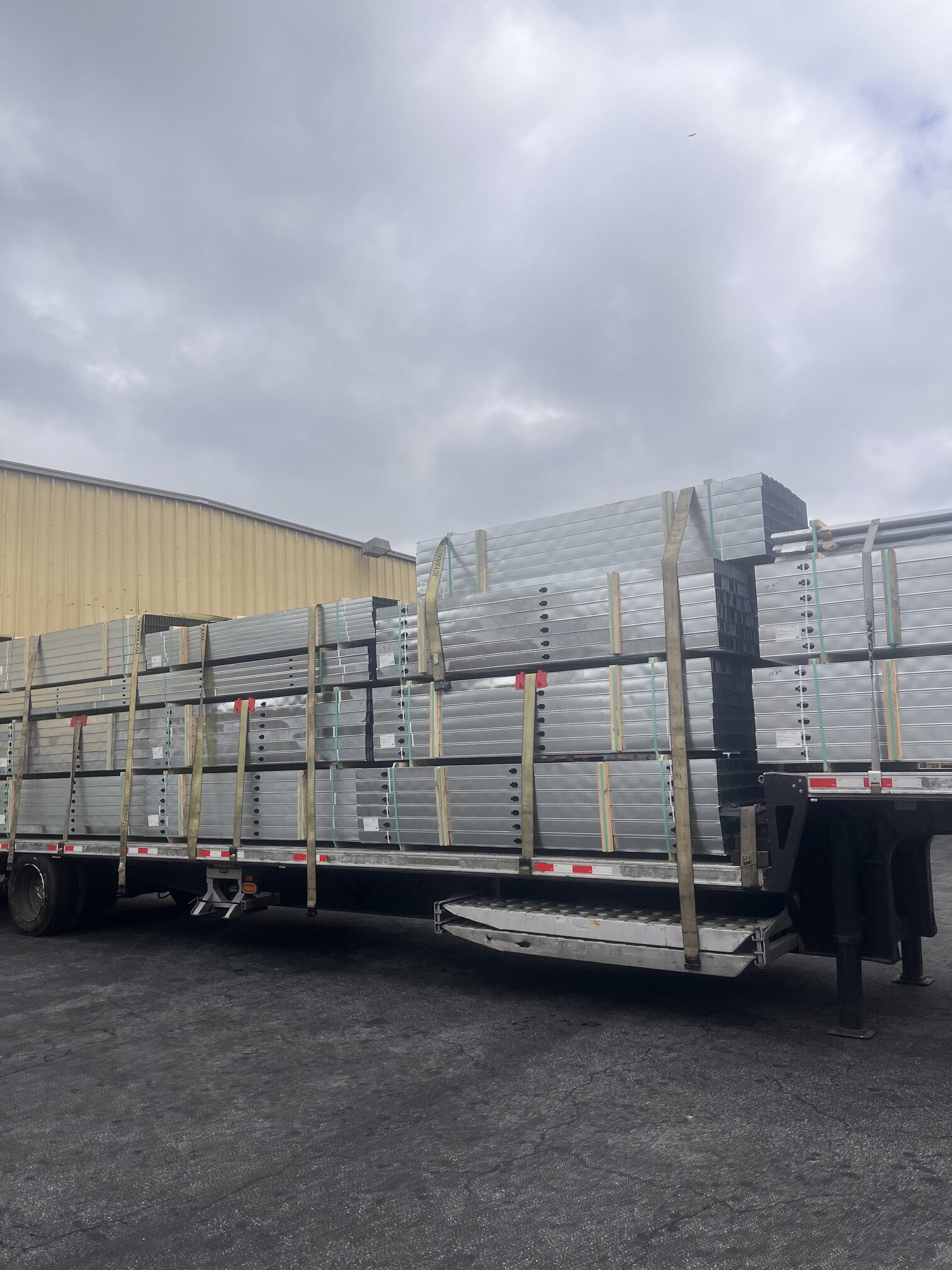
Start with the interior elevations and the accessibility sheets. Mark every cabinet run, TV location, grab bar, handrail and wall-hung fixture. Then decide what backing each one gets based on the spec: flat strap, FRT blocking or a manufactured system. Add the linear feet of flat strap to the same order as your studs and track so it shows up on the same truck. Our contractor’s buying guide walks through how to put that order together.
If the spec calls for a manufactured backing system, add it to the same order from our backing collection, which carries ClarkDietrich, Simpson Strong-Tie and The Steel Network backing.
While you’re in the drawings, check your wall heights too. Tall walls that carry heavy items still have to meet their height limits, and our limiting heights and spans tables are the quickest way to check.
The Formetal Company has been making steel studs, track and framing accessories in Forest Park, Georgia for over 65 years, and we deliver across Georgia, Florida, Tennessee, the Carolinas and Alabama. Check current pricing on our steel stud and track pricing table, build a quick estimate with the metal stud pricing calculator, or request a quote and we’ll price your studs, track and flat strap together. Need product data for the approval package? Our submittals page has you covered.
Yes, as long as there’s backing behind the drywall at the cabinet height. Screwing cabinets into bare stud flanges or drywall anchors isn’t enough for a loaded cabinet. Flat strap, wood blocking or a manufactured backing system gives the installer something solid to fasten into.
Yes, with backing. Mount makers such as Vogel’s call for a back plate on metal stud walls, and some mounts aren’t rated for metal studs at all. Full-motion mounts put the most stress on the wall, so the backing should span at least two studs.
In most cases, yes. IBC Section 603.1 allows blocking for handrails, millwork, cabinets and window and door frames in Type I and II construction. Many specs still require fire-retardant-treated wood, so check the drawings.
The 2010 ADA Standards, Section 609.8, require the grab bar, its fasteners, its mounting device and the supporting structure to handle a 250-pound force applied at any point without exceeding allowable stresses. The backing in your wall is part of that supporting structure.
Flat strap is a strip of galvanized steel screwed across the studs behind the drywall. It’s commonly used as bridging and bracing, and it also works as backing for cabinets, shelves, handrails and other wall-mounted items.